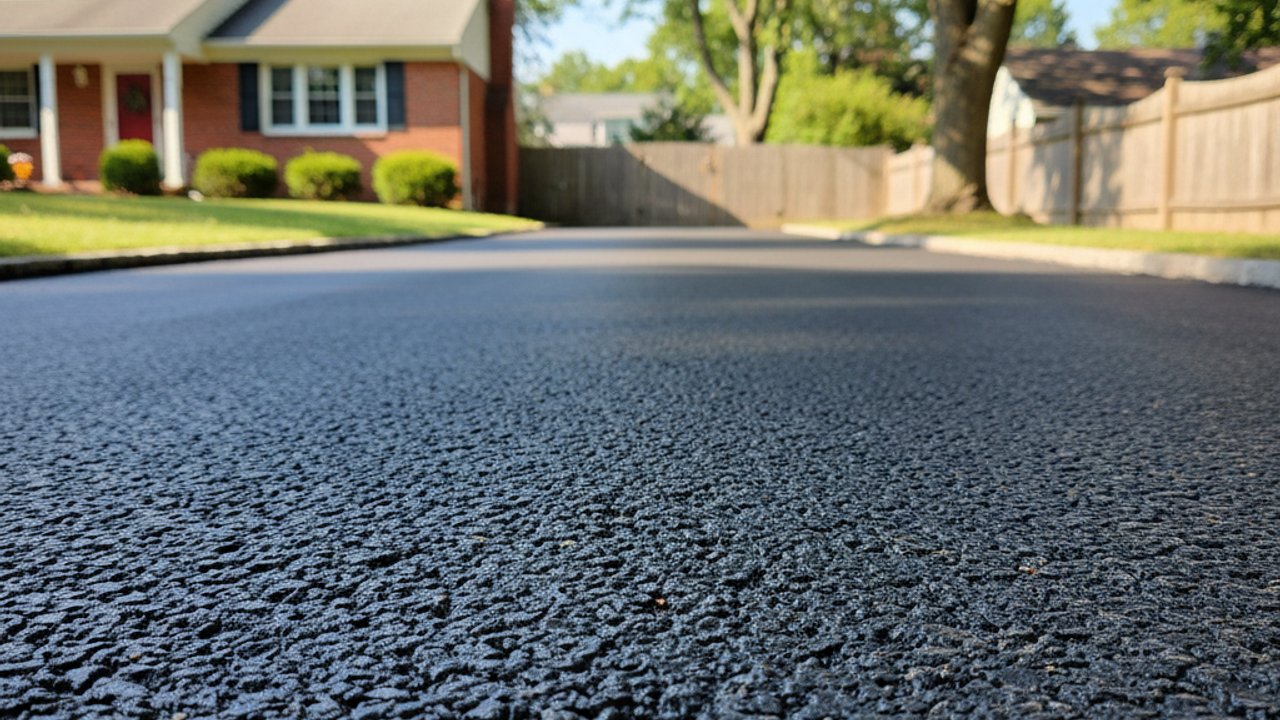
Most homeowners in Brooklyn call three contractors, get three prices, and pick the middle one. That's not a terrible system, but it misses the thing that actually matters, which is what's underneath the asphalt you can see. A driveway or a lot doesn't fail because the top layer was bad. It fails because of what was skipped before the top layer went down.
This borough gives you a specific set of problems to work around, and a contractor who knows the neighborhood will talk about them without you asking. Someone who doesn't will just talk about the finished look.
What's actually under your driveway
A lot of Brooklyn's older housing stock, the row houses in Bensonhurst, Bay Ridge, Midwood, went up in the 1920s and 30s on lots that have been cut, filled, and paved over more than once since. Dig down and you'll often find old brick, broken concrete, sometimes a layer of cinder fill from decades back. Newer construction closer to the water, in areas like Mill Basin or parts of Gerritsen Beach, sits on filled marshland, which holds moisture longer and settles unevenly if the base isn't compacted right.
Either way, the base matters more than the surface. A proper driveway base is 4 to 6 inches of compacted crushed stone, not just whatever dirt was already there smoothed flat. Skip that and you get a driveway that looks fine in October and has a dip in it by March, because the ground underneath moved and the asphalt just followed it down. Ask any contractor bidding your job what they're putting under the pavement, and how many inches. If they can't answer that in one sentence, that's your answer about them.
The weather window nobody mentions upfront
Asphalt plants around here generally stop producing hot mix by late November and don't start back up until March or April, depending on the winter. That's not a marketing detail, it's chemistry. Asphalt needs to be laid warm and compacted before it cools, and it needs ambient temperatures holding above roughly 40°F to bond properly. A contractor who tells you they can pave your driveway in January with hot mix is either wrong or using something that isn't actually hot mix.
Sealcoating has its own window. It needs dry pavement and air temperature above 50°F to cure right, which in Brooklyn usually means April through October, and even then you're watching the forecast for 24 hours of no rain after application. If someone offers to seal your driveway in November because they had a cancellation, ask why they're not booked in season.
Freeze-thaw is the thing that finds every mistake
Brooklyn gets somewhere around 60 to 70 freeze-thaw cycles a year, water gets into a crack, freezes, expands, and widens that crack, then thaws and does it again the next cold night. This is why a driveway with hairline cracks in October can have a pothole by February. It's also why patch jobs done with cold patch in winter almost never hold, cold patch is meant as a stopgap, not a repair, and a contractor who tells you it's a permanent fix is either being lazy or hoping you won't call back.
Good crack sealing happens before winter, not during it, and it's cheap insurance. A quarter-inch crack that gets filled in October is a five-minute job. The same crack left through a winter can turn into a section that needs full patching by spring.
Licensing, insurance, and the DOT curb cut
Any paving contractor working in New York City should carry general liability insurance and be able to hand you a certificate without hesitation. If your driveway apron connects to the public sidewalk or curb, that work generally falls under NYC DOT rules, and altering a curb cut usually requires a permit through the city, not just a handshake with your neighbor. A contractor who's done this before will know the process and won't act surprised when you bring it up. One who tells you permits are unnecessary for a driveway that touches the curb is telling you they haven't done this the right way before, or don't want to bother.
For larger jobs, like a parking lot behind a commercial building, you're also looking at drainage and grading that may need to account for stormwater runoff, since a lot of Brooklyn's older sewer infrastructure backs up hard in a heavy summer downpour. A lot that pools water at one corner wasn't graded right the first time.
What to walk away from
- A bid that's dramatically lower than the others with no explanation. Asphalt material and labor costs are fairly consistent across contractors in this market. A number that's 40 percent below everyone else usually means a thinner base, a thinner mat, or a plan to skip steps.
- Someone who wants full payment upfront before any material is delivered.
- No mention of compaction. If a contractor never says the word, ask directly how many passes with the roller, and what they compact between lifts, not just at the end.
- A sealcoat quote that includes no crack filling first. Sealing over cracks just hides them until they come back through.
- Pressure to sign same-day. A driveway is not an impulse purchase, and a contractor confident in their price doesn't need you to decide before you've called anyone else.
What a good conversation sounds like
Ask how many inches of base, how many inches of asphalt on top, and whether that's one lift or two. A standard residential driveway is usually 2 to 3 inches of asphalt over a compacted base, a commercial lot carrying truck traffic needs more. Ask how long before you can drive on it, most jobs need 2 to 3 days of cure before regular car traffic and up to a week before anything heavier. Ask what happens if it rains the day after paving, since water sitting on freshly laid asphalt before it's cooled and set can cause real problems.
None of this is complicated information. It's just information most homeowners never get asked to think about, because most sales pitches skip straight to the price and the timeline. A contractor who walks you through the base, the weather, and the cure time before quoting you a number is one who's done enough of these jobs in this borough to know what actually goes wrong. We cover this ground for a living, from row house driveways in Bay Ridge to lots that flood every August, and you can see more about how we handle it at Horizon Asphalt Solutions.